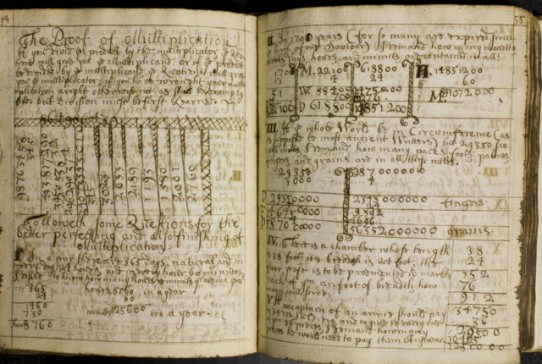
Gull. Hutton, Methodos facilis, or, A plain and easy way for attaining the knowledge and practice of common arithmetick both in whole and broken numbers opera et studio, 1701. [MS.2001.003, UCLA Clark Library]
Gull. Hutton, Methodos facilis, or, A plain and easy way for attaining the knowledge and practice of common arithmetick both in whole and broken numbers opera et studio, 1701. [MS.2001.003, UCLA Clark Library]
Though you will have to wait until the Clark reopens in 2016 to be able to consult the material in person (sorry to be a tease), we are proud to announce that the finding aid for the More House Archive is now complete and is available online! This collection originally came from More House, the home of the Hope-Nicholson family at 52 Tite Street, Chelsea (London), for over 100 years. The home was first purchased in 1892 by Adrian Hope and Laura Troubridge Hope and the archive contains items created by them, their daughter Jaqueline Hope-Nicholson and son-in-law Hedley Hope-Nicholson, and their grandchildren, especially Felix Hope-Nicholson and Marie-Jaqueline Lancaster. The Hope-Nicholsons – particularly Jaqueline, Hedley and Felix – made More House into a living museum, filled with artifacts from their lives and the lives of their ancestors and relatives (as well as things related to those they admired). The artifacts and artwork were all dispersed after unsuccessful attempts to turn the house into a research center after Felix’s death in 1990, but the archive stayed in the hands of living family members, until we purchased it in 2013.

A suitcase of letters from the More House Archive
The Troubridge-Hope-Nicholson-Gurney-Cleghorn family that emerges from the More House Archive was extremely well-connected and the archive contains material related to a wide range of 19th and 20th century figures and movements. For example, not only was More House just down the street from Oscar and Constance Wilde’s home at 34 Tite Street, but Adrian Hope was a cousin of Constance’s and became the guardian of their sons Cyril and Vyvyan after Wilde’s incarceration. Similarly, artists such as Edward Burne-Jones and John Everett Millais feature in the archive because of Laura Troubridge Hope’s career as a painter, and lesbian writer John Radclyffe Hall and her partner Una Vincenzo Troubridge are included because Una was the second wife of Laura’s brother Ernest. Other people represented in the More House Archive include John Betjeman, George Kolkhorst, Queen Victoria and the Royal Family, Trelawny Dayrell Reed, C.K. Scott-Moncrieff, Lord Alfred Douglas, Edward Scott-Snell, Harold Nicolson and Ada Leverson, among many many others.

Because the More House Archive and the family it documents is so extensive, we created a couple of supplements to help researchers. A family tree to the very extended family is online here and includes most of the family members who appear in the archive. There is also a pdf attachment showing some images of what the archive looked like before processing, when items were bundled in old suitcases and trunks. Both of these resources have links in the completed finding aid as well.
We hope that you are as excited about the More House Archive as we are!
** All of the hard work on the More House Archive was done by Erin Hurley and Rebecca Fenning Marschall, with grant funding provided by the Gladys Krieble Delmas Foundation **

You may be interested in reading an interview on the UCLA Newsroom website with our own Professor Joseph Bristow about his recent book, Oscar Wilde’s Chatterton! Oscar Wilde’s Chatterton notebook is housed here at the Clark, as the website notes, though of course, you will have to wait until we reopen in Summer 2016 to see it in person again.
We hope you will be able to join Dr. Bristow and other scholars at next week’s conference on “Oscar Wilde and the Culture of Childhood,” which will be held on campus in Royce Hall!
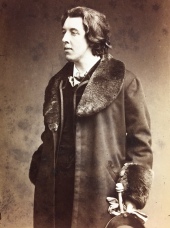
The Clark would like to congratulate Michael Stinson, who won this year’s award for undergraduate research projects executed at the Clark Library. Michael was a part of Professor Carla Pestana’s Ahmanson Undergraduate Seminar taught at the Clark and won the prize for his paper “A Good Death,” for which he used the Clark’s pirate-related holdings. A longer article about Michael and the other students who won research awards in order areas is online at the UCLA Newsroom.
Congratulations to Michael and this year’s other winners!
By Nina Schneider, Rare Books Librarian
If you haven’t heard (yet!), the Clark is closed for about fourteen months while the building is retro-fitted for earthquakes. Anyone who has experienced the world of construction knows that there is a lot of preparation required before any building activity can start. We’re taking advantage of this period—during meetings, paperwork, and site prep – to do something we’ve wanted to do for many years: reorganize the Clark Library’s fine press collection.

The books that are in the North and South book rooms are those printed in limited editions by private presses primarily during the 20th century, although there are a few 19th (and now 21st century) titles that share the shelves. Since the 1980’s these books were organized by the name of the press, and then alphabetically by main entry, title, and year. Occasionally, the Clark would receive large numbers of items that made interfiling impractical and so some of these collections were scattered wherever we could find room. Following the alphabet took the staff from the main floor of the North book room to the main floor of the South Book room to the mezzanine of the North book room to the mezzanine of the South book room. But wait…if you wanted any book printed (or collected) by Ward Ritchie, you needed to go to the mezzanine of the South book room, and then go back to the mezzanine of the North book room. The staff realized that there had to be a better way, especially after a number of paging requests took an hour (or more) to fill because of the challenge of finding the item.
Academic, public, and private libraries use different classification systems to organize their stacks. Some, such as the Dewey Decimal System and the Library of Congress classification system, organize books by subject. Small libraries organize their books by size, color, or date of acquisition. Although the Clark’s rare and reference books are organized by the Library of Congress classification system, re-classifying the press collection would be Herculean as each of the 10,000 books would need to be recataloged in order to do this. After much discussion and some trial and error, we have come up with a sustainable solution: reorganizing the current collection so that the books are shelved alphabetically by press name but then numbered according to location. For example, all books measuring 11-28 cm that were printed, designed, or written by Eric Gill are now “Press coll. Gill #”. If they measure less than 11 cm, then they are classified as “tiny”; over 28 cm are classified as “folio” or “double folio” for those over 45 cm.

We are also reorganizing how the book rooms are laid out, so that “Press coll. A…” starts on the mezzanine of the North book room, down to the main floor then over to the main floor of the South book room and ending on the mezzanine on the south side. We are allowing extra space at the end of each shelf in order to accommodate future acquisitions.
This is also an excellent opportunity to reconcile the shelf reading project undergone by some of our work/study students and our volunteer, Karen K. It has helped to locate books marked “NOS” (not on shelf) – we’ve already figured out that many of those have been moved to either the miniature book section or to the folio sections, without the updated location added to the card or catalog record.
In the end, this project will benefit both the Clark staff and our patrons. It’s a bit of a luxury to have this time to work on it.

For more information about the Clark’s seismic retrofit: http://www.c1718cs.ucla.edu/clarkclosure15.htm
For more information on library classification systems: http://www.newworldencyclopedia.org/entry/Library_classification
(See our first post on Mr. Clark’s library guest book)
Ramon Novarro was not the only Hollywood star to visit the Clark Library and sign the guest book — Mr. Clark’s guest book provides some interesting corroborating evidence about his friendship with actress Marie Dressler. There are two very friendly letters from Dressler to Mr. Clark in our institutional archive – one a condolence letter on the death of Clark’s wife Alice in 1918 and the other to thank Clark for sending flowers on her birthday in 1933. Now we know that Dressler also visited the Clark Library in 1927 and brought along her friend, the screenwriter Frances Marion.

The screenwriter of many of Mary Pickford’s biggest hits (and her best friend), Marion was also responsible for helping to rebuild Dressler’s Hollywood career in the late 1920s. She was a powerful and intelligent force in Hollywood throughout the silent period and beyond and would likely have found much to admire and appreciate about Mr. Clark’s library building and its contents.
These ladies’ names jumped out at me right away because of my academic background in film history (especially because I know and once worked for Marion’s biographer Cari Beauchamp), and I am sure that those with other areas of expertise are likely to react the same way to other names in the guest book.

(click image to see full size)
If you have any insights or information about the other folks that visited the Clark in late 1927, please leave a comment below or let us know on Facebook or Twitter! We recognize a couple of names (Mrs. Mars F. Baumgardt, near the bottom, was the wife of Mr. Clark’s astronomer), but if there is anyone here that you know (or feel like researching), we would love your help.
(and by the way, just in case you are interested, Without Lying Down, the feature-length documentary on Frances Marion based on Cari Beauchamp’s biography of the same name will be will be airing tomorrow April 25th on Turner Classic Movies, alongside several films written by Frances)
While moving material to get ready for our seismic retrofit project, I came across the Clark Library guest book, begun by William Andrews Clark, Jr. in 1924 and used until 1957, when the pages were completely filled. Because this item was stored in a different location than the rest of the Clarkive (as we affectionately call our institutional archive), I had actually never seen it before.
Bound in repurposed antiquarian binding, the guest book’s pages (at least those from the years Mr. Clark was alive; I didn’t examine the post-1934 pages closely) contain a who’s who of Clark family and friends, library and book collecting luminaries, Los Angeles and Montana society folks and a smattering of Hollywood celebrities.
 The first page of the guest book contains some of Mr. Clark’s closest colleagues and friends:
- Robert E. Cowan, Clark Librarian and bibliographer
- Cora Edgerton Sanders, Clark Librarian and longtime family employee
- Harrison Post, Assistant Librarian and Mr. Clark’s romantic partner
- John L. Templeman of Butte, UVa classmate, lawyer and close friend
- D.F. Bogardus, bookbinder from the Huntington Library
- Judge William I. Lippincott of Butte, family friend
- Robert O. Schad, Head Librarian at the Huntington Library
- Alice Millard, bookseller and owner of La Miniatura
- John Henry Nash, printer
- Robert D. Farquhar, architect of the Clark Library
- Caroline Estes Smith, secretary of the Los Angeles Philharmonic
- Parish Williams, baritone and insurance agent
- Virginia M. Tanner, widow of Walter Miller Clark, Mr. Clark’s cousin who died on the Titanic
- James R. Polsdorfer, UC Berkeley alum – his connection to Clark is unclear
- Georges Jomier, French teacher and language coach
- Allyn Cox, muralist and painter of Clark Library murals
- William A. Clark, III, Mr. Clark’s son
Other visitors documented in the book were a little bit more of a surprise:

Silent film heartthrob Ramon Novarro lived just steps away from the Clark library & estate, and was part of a tour party on April 1, 1930 that also included his close friend Florence “Pancho” Barnes (pioneering female aviator), Louis Samuel (Novarro’s assistant who built this landmark house and also embezzled most of Novarro’s money), Grace Marion Brown (Samuel’s girlfriend and an illustrator who designed some of Mr. Clark’s Christmas cards), Robert I. & Josephine Rogers (former bank executive who owned a Robert Farquhar home in Beverly Hills), and Charles and Kathleen Hamill (lawyer and member of Chicago Symphony Orchestra board of directors).
Because most of Mr. Clark’s personal correspondence and papers no longer survive, any sources for information about his extended social circle are extremely valuable to us. There are hundreds of visitors recorded between 1924 and Mr. Clark’s death in 1934, and for all of the names that I recognize, there are many more that I don’t. I will continue to share more pages from the guestbook over the coming months and will be looking for some help to uncover information about who these visitors to the library really were – the pages above can’t be the only ones that contain fascinating people. Stay tuned for more updates and more images soon!
Books of jokes and riddles have a long history. But it’s not too common to find annotated riddle books, with answers added in manuscript by historical readers. The Clark owns one such item, an exceedingly rare copy of a late-eighteenth-century Canterbury riddle book filled with “aenigmas, aenigmatical entertainments,” “one hundred rebuses,” “one hundred and twenty condundrums, twenty sentimental toasts, two acrostics, and six songs.”

title page of The Aenigmatical Repository (1772)
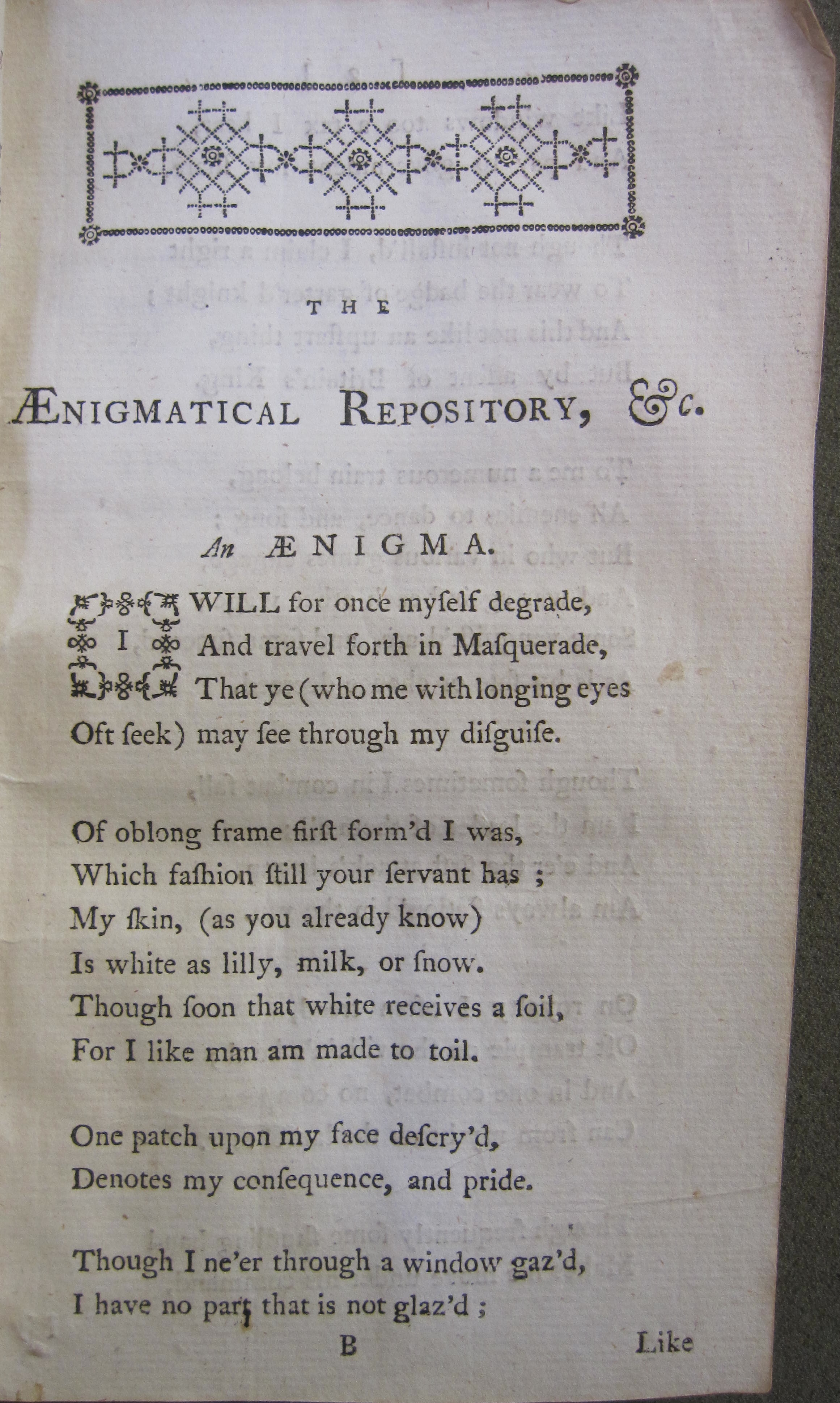
In his preface addressed “To the Public,” pseudonymous author Charles Crinkum claims the “squibs of imagination” featured in his Aenigmatical Repository; or, New Fund of Amusement (Canterbury, 1772) “may perhaps rouse the genius, and awaken the inquiry of the puerile.” The Clark’s copy of this book—one of seven surviving today and the only copy in the U.S.—is also rare because of its contemporary manuscript annotations. These handwritten additions supply answers to the text’s many word games, as in the book’s first engima:
First enigma

First enigma with solution
“For I like man am made to toil …
One patch upon my face descry’d,
Denotes my consequence, and pride …
More might be said—but now I’ll ask
My readers to remove my mask.”
The answer, of course, is “The Ace of Spades.”
Sadly, the manuscript answers in the “Desert and Liquors” section are largely illegible, thanks to an inexpert trimming and binding job:

Obscured marginalia
But answers in the “Geographical Rebuses” section came through fine:

Geographical rebuses
Apparently readers in eighteenth-century England would see the following—”A hero’s distinction, and that noted place / Where Hop-merchants harbour—a heavenly race!”—and immediately think: “Ah yes—Scarborough!” Modern readers (especially on this side of the Atlantic) have clearly lost the cultural context for deciphering and appreciating the content of some of these games.
Examples from the “one hundred and twenty condundrums” are more promising when it comes to the interpretive abilities of modern readers, though most of the answers are utterly stupid:

Conundrums
Q: “Why is a purse taken upon the highway like a clandestine marriage?”
A: “Because it is unlawful.” (Reminds me of the bad joke books I read in grade school.)
This one’s a little better:
Q: “Why is a public procession like the late Mr. Addison?”
A: “Because it produces Spectators” (With the obvious reference to Addison’s periodical The Spectator.)
The answers to one section of conundrums consist entirely of play titles:

Play title answers
E.g., “A Nocturnal Vision, on the twenty-fourth of June” = “Midsummer’s [sic] night dream.”
Another page asks readers to fill in the appropriate “Dramatic Authors”:

“Dramatic Authors”
Q: “What we are compelled to do when we are afflicted with an ague, and a warlike instrument among the antients.”
A: “Shakespeare”
It’s possible these answers were copied in part from A key to The ænigmatical repository (1772), published the same year. (There are only two copies of this even rarer Key, both in the UK and neither digitized on ECCO; thus I have not been able to determine whether the supplied answers were copied from A key or solved by the annotating reader.) A Key is advertised near the beginning of The Aenigmatical Repository: “A Key to the Aenigmatical Part of the following Publication, as also of the Rebuses and Conundrums, will speedily be Published.” But since a few pages have conundrums missing answers …

Conundrums missing manuscript answers
… it’s very likely the book’s manuscript additions came from the mind of a clever reader, and were not copied directly from a book: those answer-less conundra may have proven a bit too “aenigmatical” to solve, as in,
“Why is a printer like the stock list of farces at the Theatres Royal?”
I’ll leave you to sort that one out.
Editorial Note: The Clark’s copy of Aenigmatical Repository (1772) was on display last week (March 20, 2015) for the ASECS Conference Reception, along with a select group of materials from our rare book, manuscript, and fine press collections.
William Andrews Clark Lecture on Oscar Wilde
“Oscar Wilde and the Visual Arts”
Given by Nicholas Frankel, Virginia Commonwealth University
Tuesday, March 31, 2015, 4:00 p.m.
Oscar Wilde had much to say about the visual and decorative arts. His relationships with leading figures in the art world—notably James Whistler, Aubrey Beardsley, Edward Burne-Jones, and Charles Ricketts, as well as the critics John Ruskin, Walter Pater, and John Symonds—were integral to his ideas, and he was himself the subject for several important visual artworks, including the Clark Library’s own portrait by R. G. Harper Pennington. For students of literature, Wilde’s direct engagements with art and artists are important chiefly for their effects upon his practice as an imaginative writer. The lecture traces the influence of fine art on Wilde’s poetry, fiction, and criticism, while demonstrating the centrality of the decorative and book arts to his published work. Touched upon are Wilde’s early quarrels with Whistler over the respective merits of painting and literature. But increasingly Wilde came to see language itself as something iconic and inherently visual, and it is in his books of the early 1890s—Dorian Gray, The Sphinx, and the famous English edition of Salome, illustrated by Beardsley—that we see the full flowering of Oscar Wilde’s interest in the visual arts.

Oscar Wilde, by R.G. Harper Pennington
Nicholas Frankel is Professor of English at Virginia Commonwealth University and the author or editor of a number of books relating to Oscar Wilde, including Oscar Wilde’s Decorated Books (University of Michigan Press, 2000); Masking The Text: Essays on Literature and Mediation in the 1890s (Rivendale Press, 2009); The Sphinx, by Oscar Wilde, with Decorations by Charles Ricketts (Rice University Press, 2010); and The Picture of Dorian Gray: An Annotated Uncensored Edition (Harvard University Press, 2011). The last was named an Honor Book in both fiction and criticism categories at the 2012 Stonewall Book Awards and has been translated into Portuguese, Greek, and Italian. His annotated edition of Wilde’s The Importance of Being Earnest will appear from Harvard in 2015, and he is currently preparing further annotated editions and a new biography of Wilde for Harvard. He is the recipient of fellowships from the National Humanities Center, the National Endowment for the Humanities, the Bibliographical Society of America, and the Yale Center for British Art.
This biennial lecture on Oscar Wilde is made possible by a generous endowment founded by Mr. William Zachs.
Registration Deadline: March 26, 2015
Admission is complimentary, but advance registration is requested:
www.c1718cs.ucla.edu/wilde14-r
Please be aware that space at the Clark is limited and that registration closes when capacity is reached. Confirmation will be sent via email.

 | Dana Gioia on Granite & Cypress |
 | Ava on Marie Antoinette and Jacques-L… |
 | BRISTOW, JOSEPH on Clark Library receives grant t… |
 | Becky on Roads of Italy |
 | Ricky Pound on Roads of Italy |

 The Clog